Is It Legal to View and Download Public Instagram Content? What You Need to Know
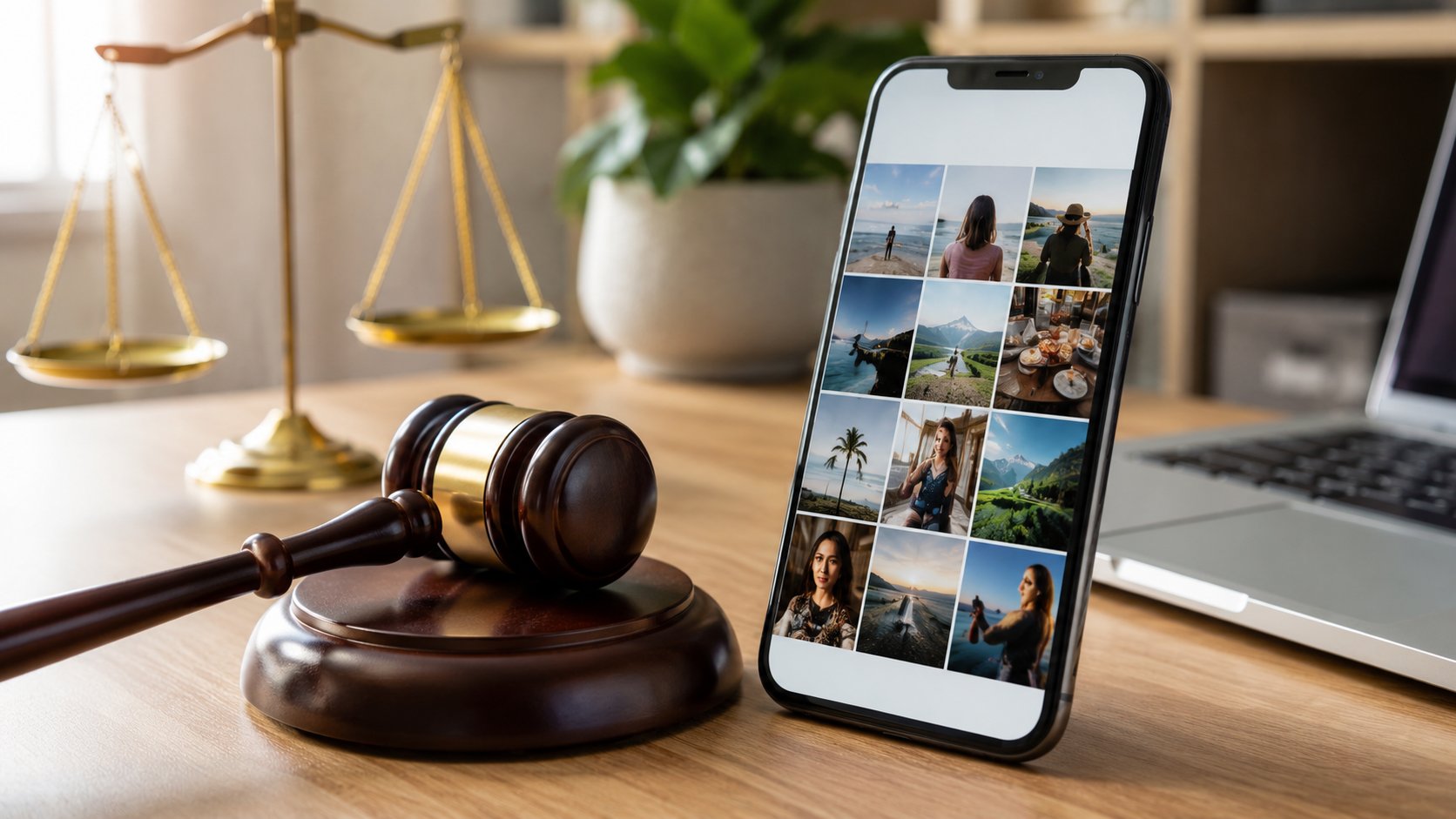
TL;DR: Viewing public Instagram content is legal essentially everywhere. Downloading it for personal use sits in a low-risk gray zone — technically against Instagram’s Terms of Service, but not a criminal matter and rarely enforced against individuals. The real legal exposure begins when you redistribute or commercially use someone else’s content without permission, which can trigger copyright liability. Accessing private accounts is where things become clearly illegal. Full breakdown below — and note, this is informational, not legal advice.
The honest starting point: “is it legal?” is the wrong question, or at least an incomplete one. Because legality here isn’t a single yes-or-no switch — it’s a layered thing, where the answer shifts depending on what you’re doing, whose content it is, what you do with it afterward, and which jurisdiction you happen to be standing in.
Viewing? Almost always fine. Downloading for yourself? Mostly fine, with an asterisk. Reposting someone’s content as your own and selling products with it? That’s where lawyers start sending letters.
Let’s untangle it properly, because the internet is awash in confident-but-wrong takes on this, and the stakes — for businesses especially — are real enough to warrant getting it right.
First, a Crucial Distinction: Terms of Service vs. Actual Law
This trips up almost everyone, so let’s nail it down before anything else.
Instagram’s Terms of Service are a contract between you and Instagram (Meta). When you signed up, you agreed to them. Violating them is a contractual breach — Instagram’s remedy is to restrict, suspend, or ban your account. That’s the extent of it. A ToS violation, by itself, is not a crime and not something that lands you in court against the government.
Actual law — copyright statutes, privacy regulations, computer-access laws — is a separate layer entirely. These apply regardless of what Instagram’s contract says, and violating them can carry real legal consequences: civil liability, statutory damages, in extreme cases criminal charges.
So when someone asks “is downloading Instagram content legal?”, the precise answer is: it may breach Instagram’s Terms of Service (a contract issue) while not violating any actual law (provided you stay within certain limits). Two different questions wearing the same coat.
|
Layer |
What It Is |
Consequence of Violating |
|---|
|
Instagram ToS |
Contract with Meta |
Account restriction or ban |
|
Copyright law |
Statutory protection for creators |
Civil liability, damages |
|
Privacy law |
Data protection regulation |
Fines, civil claims |
|
Computer access law |
Anti-hacking statutes |
Civil and potentially criminal |
Viewing Public Content: The Easy Part
Let’s get the simple case out of the way.
Viewing publicly posted Instagram content is legal. Full stop, more or less. Content that’s been made publicly accessible by its poster — on a public account, visible to anyone — carries no general legal prohibition against being looked at. That’s the whole point of posting publicly.
This holds whether you view through the Instagram app, through a browser, logged in or logged out, or through a third-party viewer like Dumpor. The act of viewing public content doesn’t infringe copyright (viewing isn’t copying in the legal sense), doesn’t violate privacy law (the content was made public by choice), and doesn’t breach computer-access statutes (you’re accessing content that was made openly available).
The one wrinkle — and it’s a ToS wrinkle, not a legal one — is that Instagram’s Terms technically restrict automated or large-scale access. But an individual viewing public profiles, even through a third-party tool, isn’t the target of those provisions, which exist to deter industrial-scale scraping operations.
Downloading: Where the Asterisks Appear
Downloading is where it gets more interesting, because now you’re making a copy — and copies are where copyright law starts paying attention.
The personal-use reality
Downloading public Instagram content for personal, private use — saving a video to watch offline, keeping a photo for personal reference, archiving something for yourself — occupies a well-established gray zone that, in practice, carries minimal legal risk.
Here’s why. Copyright law in most jurisdictions includes some concept of personal use or private copying. The exact contours differ — the US has “fair use,” the EU has private-copying provisions, the UK has limited personal-use exceptions — but the broad principle is similar: making a copy of publicly available content for your own private, non-commercial purposes rarely triggers meaningful enforcement.
No creator is realistically going to pursue you for saving their public Reel to your phone for personal viewing. The mechanics of enforcement don’t even make sense at that scale.
Where personal use ends
The protective umbrella of “personal use” evaporates the moment you do any of the following:
- Republish the content on your own social channels, site, or anywhere public
- Use it commercially — in advertising, in a product, in anything that generates revenue
- Distribute it to others at scale
- Pass it off as your own work
At that point, you’re no longer in personal-use territory. You’re potentially infringing the creator’s copyright, and “but it was public” is not a defense. Public visibility and free-to-reuse are entirely different things — a distinction worth tattooing somewhere visible if you run any kind of brand account.
Copyright: Who Owns Instagram Content?
Quick but important: when someone posts a photo or video to Instagram, they retain the copyright. Instagram doesn’t own it; the creator does. Posting to Instagram grants Instagram a broad license to display and distribute the content on the platform, but it doesn’t transfer ownership and it doesn’t give you, a third party, any rights to reuse it.
This means:
-
The person who took the photo owns it
-
Posting it publicly doesn’t surrender that ownership
-
You downloading it doesn’t grant you any usage rights beyond personal viewing
-
Reusing it commercially requires their permission, regardless of how you obtained the file
There’s a frequent misconception that “if it’s on the internet, it’s free to use.” It isn’t, and it never was. That belief has cost businesses real money in copyright settlements.
Privacy Law: The Public Content Angle
Privacy regulations — GDPR in Europe, CCPA in California, and their equivalents elsewhere — add another dimension, particularly for anyone processing Instagram content at scale or for business purposes.
The key principle most of these frameworks share: even public personal data is still personal data. The fact that someone posted a photo of themselves publicly doesn’t strip that image of all privacy protection under laws like GDPR.
For an individual saving content for personal use, privacy law is essentially a non-issue — personal/household use exemptions apply. For a business systematically collecting, storing, and processing Instagram content that contains identifiable people, the calculus changes. GDPR, for instance, may impose obligations around lawful basis, data minimization, and individual rights even for publicly sourced data.
The practical takeaway: personal use stays clear of privacy law almost entirely. Commercial or systematic use of content containing identifiable individuals is where you’d want to think carefully — and possibly consult someone qualified.
The Clear Red Line: Private Accounts
Everything above concerns public content. Private accounts are a different legal universe entirely.
Attempting to access content from a private Instagram account without authorization — through credential theft, social engineering, technical circumvention, or any tool claiming to “unlock” private profiles — potentially violates computer-access laws. In the US, that’s the Computer Fraud and Abuse Act. The EU, UK, and most other jurisdictions have equivalent legislation.
This isn’t a gray zone. It’s not a ToS technicality. Unauthorized access to private accounts is the kind of thing that carries genuine legal weight, including potential criminal liability.
Which is why legitimate tools — Dumpor included — only work with public content. Any service promising access to private accounts is either lying about its capabilities or operating illegally. Both are reasons to stay well clear.
Legality at a Glance
|
Activity |
Legal Status |
Notes |
|---|
|
Viewing public content |
✅ Legal |
No restriction on looking |
|
Downloading public content (personal use) |
⚠️ Gray, low risk |
ToS breach, minimal legal exposure |
|
Reposting others’ content publicly |
❌ Risky |
Potential copyright infringement |
|
Commercial use without license |
❌ Illegal |
Copyright liability |
|
Accessing private accounts |
❌ Illegal |
Computer-access law violation |
|
Using content to harass/defame |
❌ Illegal |
Separate legal liability |
|
Saving your own content |
✅ Legal |
It’s yours |
How This Applies to Viewer and Downloader Tools
Tools like Dumpor sit squarely on the legal side of these lines, by design:
-
They access only public content — never private accounts
-
They facilitate viewing and personal downloading, which fall within the low-risk personal-use zone
-
They don’t store your data, require your Instagram credentials, or process content commercially on your behalf
-
What you do with downloaded content afterward is where your own legal responsibility kicks in
In other words: the tool stays in bounds. The legality of your specific use depends on your specific actions after the download. Saving a competitor’s public Reel to analyze internally — fine. Taking that Reel and running it as your own ad — not fine, regardless of the tool used to obtain it.
For anonymous viewing specifically — browsing public profiles or watching Stories without registering your identity — the legal picture is even simpler, since no copying occurs at all. The Instagram Story Viewer and Profile Viewer functions involve viewing, not reproduction, placing them firmly in the unambiguously-legal category.
Regional Variation Worth Knowing
The broad principles are similar across jurisdictions, but details differ:
- United States: “Fair use” doctrine offers some flexibility for personal, transformative, or commentary use. ToS breaches are civil, not criminal. CFAA governs unauthorized access.
- European Union: Private-copying exceptions exist but are narrower than US fair use. GDPR adds data-protection obligations for processing personal data, including public content, at scale.
- United Kingdom: Post-Brexit, broadly similar to the EU with its own copyright and data-protection framework.
- Other regions: Most have some combination of copyright protection, anti-hacking statutes, and increasingly, data-protection law. The “public ≠ free to reuse” principle is close to universal.
If your use is personal and limited, these regional differences rarely matter. If your use is commercial or systematic, they matter quite a lot — and professional advice for your specific jurisdiction becomes worthwhile.
FAQ
Frequently Asked Questions
Q: Is it illegal to download someone’s Instagram photo?+
For personal use, no — it’s a gray area that breaches Instagram’s Terms of Service but doesn’t violate actual law in any practically enforceable way. It becomes legally risky only if you republish or commercially use the photo without the creator’s permission.
Q: Can I get in trouble for using an Instagram viewer or downloader tool?+
For viewing and personal-use downloading of public content, realistically no. These tools operate in the same low-risk zone as the activity itself. The legal responsibility attaches to what you do with the content, not the tool you used to access it.
Q: Does “public” mean I can reuse the content freely?+
No — this is the single most common and most expensive misconception. Public visibility means people can see and view the content. It does not transfer copyright or grant reuse rights. The creator still owns it, and commercial reuse without permission is infringement.
Q: Is downloading my own Instagram content legal?+
Completely. It’s your content, you own the copyright, and you can download, save, and reuse it however you like. The only mild friction is that Instagram’s native export tools are clunky, which is why people use third-party tools even for their own content.
Q: What about downloading content for a school or research project?+
Educational and research use often enjoys broader latitude under fair use (US) and similar exceptions elsewhere — particularly for commentary, criticism, or scholarship. The specifics depend on jurisdiction and exact use, but academic use generally sits on safer ground than commercial use.
Q: Can a creator sue me for saving their public Reel?+
In theory, copyright law would allow a creator to pursue infringement claims. In practice, for personal-use saving with no redistribution, this essentially never happens — there’s no damage to claim and no economic logic to pursuing it. The realistic risk arises only with public reposting or commercial use.
Q: Is it legal to view Stories anonymously through a tool?+
Yes. Viewing public Stories — anonymously or otherwise — is legal. Anonymous viewing tools simply change whether your identity registers with the poster; they don’t change the legality of the viewing itself, which was already permitted.
Q: Does Instagram’s Terms of Service have legal force?+
The ToS is a binding contract, so it has contractual force — Instagram can enforce it by restricting your account. But it’s not the law. Breaching the ToS isn’t a crime, and Instagram’s only practical remedy against an individual is account-level action.
Q: What’s the safest way to stay on the right side of all this?+
+
Keep it simple: view freely, download for genuine personal use only, never repost or commercially use others’ content without permission, and never attempt to access private accounts. Stay inside those lines and you’re firmly in low-risk territory.
The Bottom Line
So — is it legal to view and download public Instagram content? Viewing: yes, unambiguously. Downloading for personal use: a low-risk gray zone, technically a ToS breach but not a legal violation in any practical sense. The genuine legal lines are two — redistribution/commercial use of others’ content, and accessing private accounts. Stay clear of both and you’ve sidestepped essentially all real exposure.
Tools like Dumpor are built to operate within these boundaries: public content only, viewing and personal downloading, no private-account access, no credential harvesting. The tool keeps itself in bounds. Your job is simply to keep your use of the content in bounds too — which, for the overwhelming majority of people just wanting to save or view something, happens automatically.
This article is informational and reflects general principles as of 2026. It is not legal advice. For specific situations — particularly commercial use — consult a qualified attorney in your jurisdiction.

 Telegram bot
|
TikTok Viewer