How Instagram Detects Bots and Automation in 2026
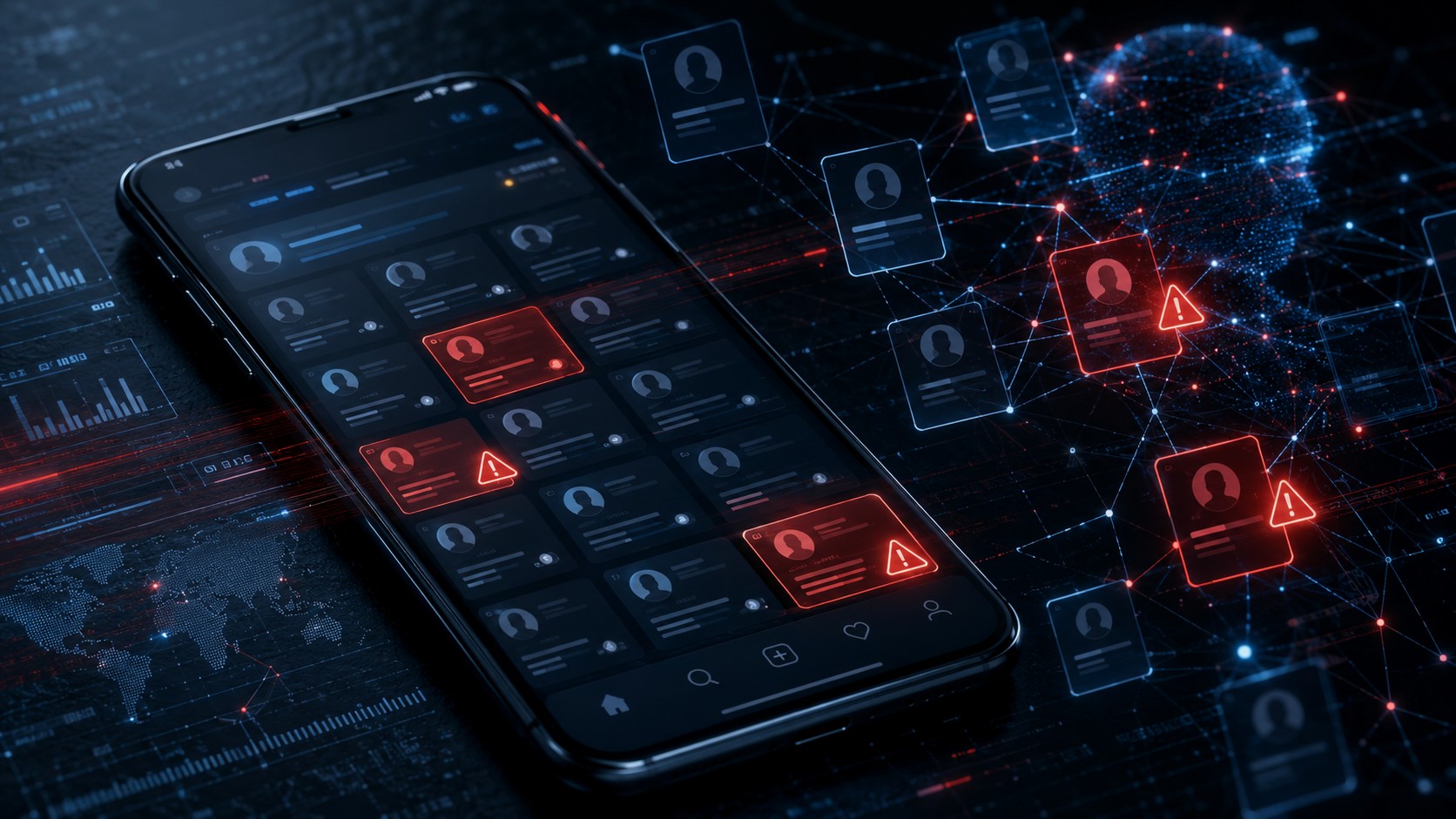
TL;DR: Instagram no longer just counts your actions — it studies how you perform them. In 2026, detection runs on machine-learning models that build a behavioral fingerprint of every account: timing rhythms, mouse and tap patterns, device and network signals, and the tell-tale regularity that only scripts produce. Bots get flagged not because they do too much, but because they do it too perfectly — no hesitation, no idle scrolling, no human mess. The takeaway for anyone doing legitimate research, competitor analysis, or data-gathering: don’t automate actions on a logged-in account at all. Use a read-only, no-login tool instead. Our profile viewer lets you study public accounts without touching Instagram’s login system — meaning there’s no account to flag in the first place.
The bots of 2018 were laughably easy to catch. Follow five hundred people an hour, like a thousand posts before lunch, leave “🔥 great post!” on everything that moved — Instagram just counted the numbers, saw they blew past any human ceiling, and dropped the hammer. Crude tools, crude detection. Both sides have evolved since.
What Instagram does now is a different animal entirely. It has largely stopped asking “how much?” and started asking “how?” And that shift, quiet as it was, gutted the entire automation industry — because you can throttle a bot’s speed to look human, but making it behave human is a far taller order.
From counting to profiling: what changed
The old system was rule-based. Cross a threshold, get flagged. Simple to build, simple to evade — just stay under the limits.
The 2026 system is behavioral. Meta feeds enormous volumes of interaction data into machine-learning models trained on one deceptively hard question: does this pattern of activity look like a person, or like a program pretending to be one? The models don’t care that you followed forty accounts today instead of four hundred. They care that you followed them at intervals of exactly 34 seconds, from the same IP, with no scrolling in between, at 3 a.m., for the ninth day running.
Humans are gloriously inconsistent. We get distracted. We double-tap by accident, then unlike. We open the app, stare at one Reel for six minutes, forget why we came, and close it. Bots don’t do any of that — and their very tidiness is the fingerprint.
The signals Instagram actually watches
Detection isn’t one test; it’s a stack of them, cross-referenced. Here’s what feeds the models.
|
Signal category |
What it measures |
What trips the flag |
|---|
|
Timing & rhythm |
Intervals between actions |
Machine-perfect regularity, no natural pauses |
|
Action ratios |
Follows vs. likes vs. comments vs. views |
Lopsided profiles (mass-follow, zero browsing) |
|
Session shape |
How a session starts, flows, ends |
No idle time, no scrolling, pure action |
|
Device fingerprint |
Hardware, OS, app build, sensors |
Emulators, mismatched or spoofed device data |
|
Network signals |
IP, ASN, proxy/VPN reputation |
Datacenter IPs, known proxy pools, sudden geo-jumps |
|
Content patterns |
Comment text, hashtag reuse |
Identical strings pasted across many posts |
|
Engagement quality |
Who reacts, how fast, from where |
Bursts from bot clusters, no genuine dwell time |
No single row gets you banned. It’s the combination — a datacenter IP plus metronomic timing plus a follow-only action ratio plus copy-pasted comments — that lights up the board. Detection is a mosaic, not a tripwire.
Behavioral fingerprinting, in plain terms
This is the heart of it. Every time you tap, swipe, pause, and type, you leave a micro-signature — the speed of your scroll, the slight variance in how long you linger, the way you sometimes backtrack. Real humans generate rich, noisy, unpredictable versions of these signals. Automation generates clean, repeatable ones, because that’s what code does.
The models have seen billions of both. Distinguishing them has become, frankly, not that hard for a well-trained classifier.
What the detection net catches (and what it misses)
Worth being precise here, because the internet is full of half-truths.
Caught reliably:
-
Auto-followers and auto-unfollowers (the mass follow/unfollow churn is glaringly non-human)
-
Auto-likers and auto-commenters, especially with recycled text
-
Engagement pods and follower-buying (the bought accounts themselves get purged in waves)
-
Emulator-based bots and datacenter-hosted automation
Harder to catch (but not safe):
-
Slow, “humanized” automation that randomizes timing — still detectable over weeks, because the underlying regularity leaks through eventually
-
Residential-proxy bots — better disguised on the network layer, but still betrayed by behavioral signals
The pattern is consistent: hiding one signal doesn’t save you, because the model reads the whole stack. Beat the timing test and the action-ratio test still nails you. Beat both and the device fingerprint does. It’s whack-a-mole, and the house has more moles than you have mallets.
What happens when you get flagged
Instagram’s response scales with severity, and it rarely announces itself:
- Soft throttling. Your actions silently stop working — a follow that doesn’t stick, a like that vanishes. No error, just quiet failure.
- Action blocks. Temporary bans on specific actions (“Try again later”), lasting hours to days.
- Reach suppression. The shadowban territory — your distribution gets clipped even if your actions still register.
- Verification challenges. Forced phone or email re-verification, sometimes a selfie video.
- Permanent suspension. For repeat or egregious offenders, the account’s gone, and appeals are a coin toss at best.
The cruel twist: because detection now leans on gradual behavioral scoring, punishment often arrives after you’ve stopped, when the model’s confidence finally crosses its threshold. People swear they “did nothing” — and by the time the ban lands, that’s technically true.
The safe alternative: don’t automate a logged-in account at all
Here’s the thing most guides tiptoe around. If your goal is legitimate — researching competitors, studying content trends, gathering public data, monitoring a niche — you don’t need automation on your account, and you certainly don’t need to risk your account to get it.
The risk lives entirely in acting through a logged-in profile: the follows, likes, and comments that automation performs. Reading public information carries none of that risk, provided you do it without logging in.
That’s the whole design principle behind our tools. When you open the Instagram profile viewer, you’re browsing public content from outside Instagram’s login system — there’s no session to fingerprint, no action ratio to skew, no account to flag, because you’re not performing account actions at all. You’re simply viewing what’s already public, the way any logged-out visitor would.
The same logic covers the common research jobs people wrongly reach for bots to handle. Want to track how a competitor’s followers grow week over week? The followers and following viewer shows public follower data without you mass-visiting profiles from your own account (which is exactly the behavior detection loves to catch). Need to archive public posts for a swipe file or a trend report? A photo downloader pulls them cleanly, no automated scrolling-and-saving spree that a script would perform and a model would notice.
Read-only, no login, public content only. It sidesteps the entire detection apparatus for the simple reason that there’s nothing for it to detect.
Myths that get accounts banned
A surprising number of suspensions trace back not to reckless automation, but to bad advice confidently repeated across forums. Let’s puncture a few.
- “Small bots are invisible.” The idea that staying under some magic daily number keeps you safe belongs to 2018. Modern detection weighs pattern over volume, so a tiny, tidy, perfectly regular bot can flag faster than a busy but genuinely human account. Size was never the real signal.
- “Residential proxies make me untouchable.” They improve your network reputation, sure — one signal out of many. Your behavior, device fingerprint, and action ratios keep broadcasting loudly regardless of whose IP you borrow. A well-disguised network wrapped around metronomic behavior is still a bot to the model.
- “If I get away with it for a month, I’m clear.” Detection is retrospective. The models score behavior over long windows and act when confidence peaks, which is precisely why so many bans feel like they arrive out of nowhere, days after the person stopped. A quiet month isn’t a pardon; sometimes it’s the incubation period.
- “Instagram can’t tell an emulator from a phone.” It absolutely can. Emulators lack the messy sensor data — accelerometer jitter, touch-pressure variance, battery quirks — that real devices constantly emit. That absence is itself a red flag, and a loud one.
The common thread: every myth fixates on beating a single signal, while the actual system reads dozens at once. Optimizing one dimension just relocates your visibility to the others.
A quick self-check: does your activity look human?
If you run a real account and worry you might be brushing against these tripwires by accident, run through this honestly:
-
Do you ever perform the same action dozens of times in a tight burst? (Mass follow-backs after a viral post are the classic innocent trigger.)
-
Do you use third-party apps that act on your behalf — schedulers that also like or comment, “growth” services, engagement pods?
-
Does your session ever consist purely of actions, with zero browsing or idle time?
-
Are you routing through a shared or datacenter IP that other, sketchier accounts also use?
Two or more yeses, and you’re closer to the flag line than you’d think — not because you’re a bot, but because you’re producing bot-shaped signals. Spacing out activity, cutting third-party action tools, and simply using the app like a human (scroll, linger, wander) pulls you back into safe territory.
Can Instagram detect automation even if I slow the bot down to human speed?+
Usually, yes — eventually. Slowing a bot defeats the crude speed check, but detection in 2026 isn’t primarily about speed. It’s about the shape of behavior: the unnatural regularity, the missing idle time, the lopsided action ratios, the device and network signals. Randomized timing helps a bot survive longer, but the underlying pattern tends to surface over days and weeks, and that’s the window the models work in.
Do “humanized” or “AI-powered” growth tools actually avoid detection?+
Better than crude bots, but “avoids detection” is a marketing claim, not a guarantee. These tools randomize timing and mimic human rhythms, which raises the bar — yet they still perform automated actions from your logged-in account, still often route through detectable networks, and still generate patterns a mature classifier can spot across a long enough timeline. The safest number of automated actions on an account you value remains zero.
Is using a VPN enough to hide automation from Instagram?+
No. A VPN masks your IP, which addresses exactly one signal in a large stack. Behavioral fingerprinting, device signals, action ratios, and content patterns all keep working regardless of your IP. Worse, low-quality VPN and datacenter IPs carry poor reputation scores that can increase suspicion rather than reduce it. A VPN is not an automation shield.
Will viewing profiles through an anonymous tool get me flagged?+
No, because you’re not performing any account actions. Anonymous viewers read public content from outside the login system — there’s no account session generating signals, no follows or likes being automated, nothing for the detection models to score. That’s the fundamental difference between acting on the platform (risky when automated) and reading what’s public (safe).
I never used a bot, but I got an action block. Why?+
Detection isn’t perfect, and false positives happen. Common innocent triggers: doing a lot of the same action quickly (following back fifty people after a shoutout), using public Wi-Fi that shares an IP with actual bots, or logging in from a new country while traveling. These blocks are usually temporary — wait it out, avoid repeating the burst, and normal use resumes. If it persists, verify your account through the prompts Instagram provides.
Does Instagram delete bought followers automatically?+
Regularly. Meta runs periodic purges that wipe fake and inactive accounts across the platform, which is why people who buy followers watch their counts crater overnight during a sweep. Beyond the embarrassment, buying followers poisons your engagement ratios (thousands of followers, dozens of likes) — a signal that itself invites scrutiny. It’s a bad trade twice over.
The arms race between Instagram and the automation industry has quietly tilted, and in 2026 the platform is winning it more often than not. Behavioral fingerprinting made the old evasion tricks obsolete, and the tools promising to outsmart it are, for the most part, selling you a slower way to lose your account. The genuine insight is simpler than any workaround: if what you need is information, not action, you never have to enter the ring. Browse and research public accounts without logging in — no bot, no risk, nothing to detect.

 Telegram bot
|
TikTok Viewer