How to Compare Two Public Instagram Profiles Properly
TL;DR
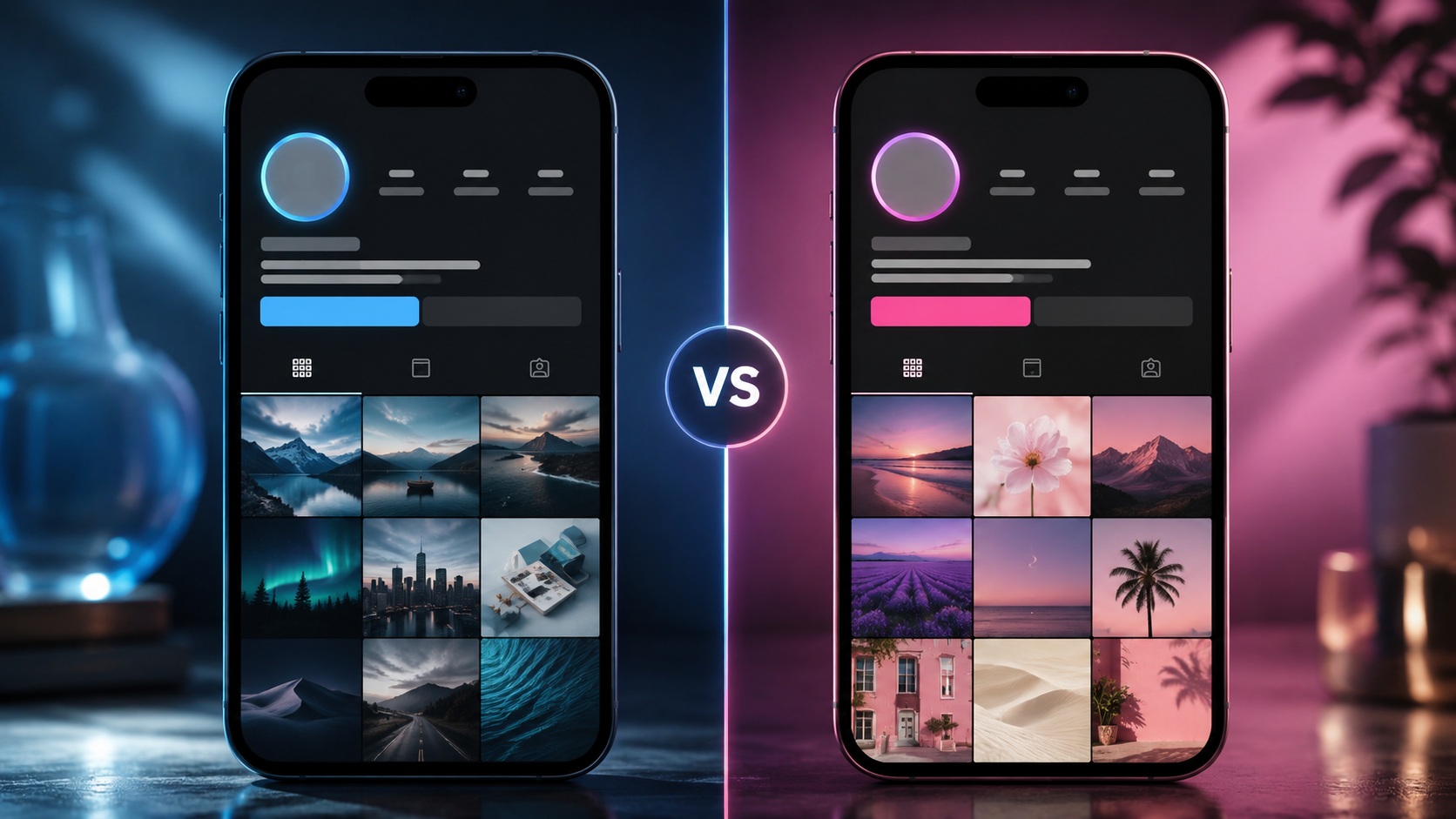
To compare two public Instagram profiles side by side, do not start by asking which account has more followers. Start by making sure the two accounts are genuinely comparable, then review the same public signals over the same period.
A useful comparison should cover:
-
follower and following counts;
-
profile positioning and bio;
-
website and external links;
-
posting frequency;
-
Reels, carousels, and image mix;
-
recurring content themes;
-
visible likes and comments where available;
-
top-performing recent posts;
-
tagged and collaborative content;
-
current Stories and Highlights;
-
calls to action;
-
consistency over time.
If likes are publicly visible, you can calculate a simple visible engagement estimate using average likes and comments divided by follower count. Treat it as a rough benchmark—not a measurement of actual reach, saves, shares, or sales.
For public-profile research without signing into Instagram, open each username through Dumpor in separate browser tabs and compare the same categories rather than jumping randomly between profiles.
Two Instagram profiles can look remarkably similar from ten paces.
Same niche. Similar pastel grid. Both have roughly 80,000 followers. Both publish three or four times a week. One even seems slightly larger, so—case closed?
Not quite.
Open them side by side and the differences begin to wriggle out. One account posts original Reels almost daily; the other leans heavily on polished static photographs. One receives thoughtful comments from obvious customers. The other gets rows of fire emojis. One tells you exactly what the business does within five seconds. The second bio is stylish but oddly vague.
Follower count did not tell you any of that.
A useful Instagram profile comparison is less like checking a scoreboard and more like comparing two shop windows while occasionally stepping inside.
What Does “Compare Two Instagram Profiles” Actually Mean?
The answer depends on why you are comparing them.
A marketing team evaluating two competitors needs different information from a brand selecting between two creators. A creator benchmarking another creator may care about posting rhythm and content formats, while a customer checking two businesses may care more about clarity, activity, real-world tags, and recent posts.
Before opening twenty tabs, define the question.
|
Goal |
Metrics and signals to prioritize |
|---|
|
Competitor research |
Content themes, frequency, positioning, formats, visible engagement |
|
Influencer comparison |
Audience size, visible interaction, content fit, consistency |
|
Brand benchmarking |
Bio, CTA, campaigns, Reels, UGC, posting cadence |
|
Creator research |
Format mix, hooks, topics, recurring series |
|
Authenticity check |
Account history clues, content continuity, tagged posts |
|
Partnership research |
Brand fit, collaborations, comment quality, recent activity |
There is no universal “best profile.”
There is only the stronger profile for the question you are asking.
Step 1: Make Sure You Are Comparing Like With Like
This sounds obvious. It is frequently ignored.
Comparing a local specialty coffee shop with Starbucks tells you very little about whether the local shop is doing Instagram well. Their resources, audience size, posting volume, brand recognition, and objectives are wildly different.
Choose profiles that share at least a few characteristics:
-
similar niche;
-
comparable market;
-
similar audience;
-
similar geographic scope;
-
roughly similar account size;
-
similar business model;
-
similar content purpose.
You do not need perfect twins. You need enough overlap for the comparison to mean something.
Otherwise, the biggest account tends to “win” every superficial metric while teaching you almost nothing.
Step 2: Put the Profiles Literally Side by Side
Do not trust memory.
Open Profile A in one browser tab or window and Profile B in another. On desktop, place the windows next to each other. On a phone, take structured notes rather than repeatedly switching back and forth.
For public accounts, you can also open both usernames through Dumpor and keep the profiles in separate tabs.
Then compare the same thing at the same time:
-
bio against bio;
-
recent grid against recent grid;
-
Reels against Reels;
-
posting dates against posting dates;
-
tagged section against tagged section.
This sounds almost too simple. It works because it prevents selective attention.
Without a side-by-side structure, people tend to notice Profile A’s best Reel and Profile B’s follower number, then compare two completely different signals.
Step 3: Compare the Profile Header First
Before analyzing content, look at the first screen.
Record:
-
username;
-
display name;
-
profile picture;
-
follower count;
-
following count;
-
number of posts;
-
bio;
-
category, if displayed;
-
location information;
-
website or link;
-
call to action.
Then ask a very human question:
If I knew nothing about these accounts, which one would I understand faster?
A good bio usually answers some combination of:
-
Who are you?
-
What do you make or offer?
-
Who is it for?
-
Where are you?
-
What should I do next?
A profile can have magnificent content and still waste the first five seconds.
For visual identity comparisons, viewing an Instagram profile picture in full size can also help when logos or profile images are difficult to inspect in Instagram’s small interface.
Step 4: Do Not Overvalue Follower Count
Follower count is useful. It is also irresistible bait for bad conclusions.
Suppose:
-
Profile A: 120,000 followers
-
Profile B: 42,000 followers
Profile A has the larger audience. That much is factual.
It does not automatically follow that Profile A has:
-
better content;
-
stronger customer relationships;
-
higher reach per post;
-
better conversion;
-
a more relevant audience;
-
faster current growth;
-
better partnership value.
Audience size is a scale metric. It is not a quality certificate.
Write it down, then keep moving.
Step 5: Compare Posting Frequency Over the Same Period
Pick a window. Thirty days works for active accounts; 60 or 90 days can be better for slower publishers.
Count posts during exactly the same period.
For example:
|
Metric |
Profile A |
Profile B |
|---|
|
Posts in last 30 days |
18 |
9 |
|
Reels |
10 |
2 |
|
Carousels |
5 |
5 |
|
Single images |
3 |
2 |
|
Approx. posts/week |
4.2 |
2.1 |
Now you have something useful.
Profile A is not merely “more active.” You can see how the activity differs.
Posting frequency also gives context to follower numbers. An account producing twenty pieces of public content a month has a different strategy from one publishing twice.
Neither strategy is automatically superior.
Consistency matters more than raw volume.
Step 6: Compare the Content Mix
Instagram profiles increasingly operate across several formats.
Separate them.
Reels
Look for:
-
original video versus reused clips;
-
talking-head versus visual demonstration;
-
hooks in the opening seconds;
-
recurring Reel series;
-
tutorials;
-
entertainment;
-
product-led video.
Carousels
Look for:
-
educational slides;
-
before-and-after sequences;
-
product collections;
-
photography series;
-
step-by-step guides;
-
storytelling.
Static Images
Look for:
-
product photography;
-
campaign images;
-
announcements;
-
quotes;
-
editorial photography;
-
user-generated material.
A profile publishing the same format repeatedly may be deliberately specialized—or simply stuck.
Side-by-side comparison makes that visible.
Step 7: Map the Main Content Themes
Format tells you how they publish. Themes tell you what they talk about.
Take the latest 15–30 posts from each account and assign simple categories.
A hotel might produce:
-
rooms;
-
food;
-
destination guides;
-
guests;
-
staff;
-
offers;
-
events.
A fitness creator might publish:
-
workouts;
-
nutrition;
-
motivation;
-
personal updates;
-
product partnerships;
-
client stories.
Then count roughly.
You may discover that two apparent competitors have completely different editorial strategies.
One hotel sells rooms. The other sells the city.
That difference is far more interesting than a 7,000-follower gap.
Step 8: Compare Visible Engagement Carefully
When public likes and comments are available, record them across a consistent sample—say the latest 10 or 12 comparable posts.
A simple visible engagement estimate is:
Average likes + average comments ÷ followers × 100
Example:
Profile A:
(2,400 likes + 90 comments) ÷ 100,000 followers × 100 = 2.49%
Profile B:
(1,100 likes + 85 comments) ÷ 40,000 followers × 100 = 2.96%
Profile A receives more visible interactions in absolute numbers.
Profile B receives more relative to its follower base.
Two different answers.
Why This Number Has Limits
Public outsiders generally cannot see the complete analytics available to the account owner.
You may not know:
-
reach;
-
impressions;
-
saves;
-
shares;
-
profile visits;
-
website clicks;
-
follower conversions;
-
Story completion;
-
sales.
Like counts can also be hidden, and different formats behave differently.
So call your calculation what it is: a visible engagement estimate.
Not “the account’s true engagement.”
That little bit of discipline prevents a surprising amount of nonsense.
Step 9: Read the Comments, Not Just the Count
Twenty meaningful comments can be more revealing than 400 generic ones.
Look at several recent posts and ask:
-
Are people asking questions?
-
Do customers mention using the product?
-
Are commenters discussing the subject?
-
Does the account reply?
-
Are conversations continuing?
-
Do the same accounts repeatedly leave generic reactions?
Do not try to diagnose “fake followers” from a handful of emoji comments. That requires more evidence than casual observation can provide.
What you can compare is visible conversation quality.
Account A may receive fewer comments but consistently answer customers. Account B may receive more reactions yet barely participate.
For a customer-facing business, that is worth noticing.
Step 10: Compare Top Posts—but Use the Same Window
Cherry-picking ruins comparisons.
If you select Profile A’s viral post from 2022 and compare it with Profile B’s ordinary Tuesday Reel from last week, the result means nothing.
Choose a fixed period:
-
last 30 days;
-
last 90 days;
-
latest 20 posts.
Identify the strongest visible posts for each profile and ask what they have in common.
Maybe the winner is always:
-
a face rather than a product;
-
a tutorial;
-
a carousel;
-
a controversial opinion;
-
behind-the-scenes footage;
-
customer content;
-
short-form video.
That is where competitor comparison starts turning into strategy.
You are no longer asking, “Who did better?”
You are asking, “What repeatedly works?”
Much better question.
Step 11: Compare Captions and Calls to Action
Captions reveal positioning that thumbnails cannot.
Read several from each account.
Check:
-
opening sentence;
-
caption length;
-
keyword use;
-
tone;
-
storytelling;
-
product information;
-
questions;
-
CTAs;
-
hashtags;
-
location references.
Then look for patterns.
Does one profile repeatedly say “shop now,” while the other encourages comments? Does one explain products in detail? Does one barely write captions at all?
A profile comparison should capture communication strategy, not merely the decoration around it.
Step 12: Check Tagged and Collaborative Content
A brand’s own feed is self-selected.
The Tagged section shows part of the outside world.
Look at publicly visible tagged posts and ask:
-
Do customers tag the brand?
-
Do creators feature it?
-
Is the account present at events?
-
Are there repeated collaborations?
-
Does the tagged content match the brand’s positioning?
Remember that Instagram users can approve, hide, or remove tags, so a Tagged grid should not be treated as a complete historical archive.
Still, comparing Profile A’s vibrant customer-tagged section with Profile B’s nearly empty one can generate useful questions.
Just do not turn those questions into conclusions without evidence.
Step 13: Compare Stories and Highlights
Feed analysis is only half the picture for active accounts.
Look at public Highlights:
-
How many are there?
-
What are they called?
-
Are they current?
-
Do they answer common customer questions?
-
Do they show products, locations, reviews, FAQs, or events?
Then check active public Stories when available.
A profile may publish feed posts twice a week yet run Stories every day.
For public accounts, Dumpor’s viewer can help with available Story research without requiring you to sign into Instagram.
Stories are particularly useful for seeing what the account considers worth communicating right now rather than what deserves permanent grid space.
Build One Comparison Scorecard
A simple sheet beats vague impressions.
Try this:
|
Category |
Profile A |
Profile B |
Notes |
|---|
|
Followers | | |
Scale only |
|
Bio clarity | | | |
|
Posting frequency | | |
Same period |
|
Reel frequency | | | |
|
Carousel use | | | |
|
Visible engagement | | |
Estimate only |
|
Comment quality | | | |
|
Content variety | | | |
|
Clear CTA | | | |
|
Tagged activity | | |
Publicly visible |
|
Story activity | | |
Snapshot |
|
Highlight usefulness | | | |
|
Brand consistency | | | |
Do not force every row into a score out of ten.
Some things are better described with one sentence.
That is fine. Numbers are tools, not decorative authority.
How Brands Should Compare Competitors
If you are conducting competitive research, the goal should not be imitation.
Look for gaps.
Suppose your competitor posts excellent product Reels but never answers customer questions in captions. That is an opening.
Perhaps they publish constantly but have no useful Highlights.
Another opening.
Maybe they rely almost entirely on studio photography while customers repeatedly tag the product in interesting real-world situations.
There is your content idea.
The valuable outcome of competitor analysis is not:
“They have 31% more followers.”
It is:
“They are consistently strong at X, weak at Y, and the audience visibly responds to Z.”
Now you can make a decision.
Comparing Two Influencers for a Partnership
For creator selection, resist the follower-count reflex.
Compare:
-
relevance to your category;
-
consistency of recent posting;
-
visible interaction;
-
comment quality;
-
branded-content frequency;
-
previous partnerships;
-
visual and editorial fit;
-
audience context visible from content;
-
whether sponsored posts feel natural;
-
consistency between claimed niche and actual output.
A 50,000-follower specialist whose audience clearly cares about your category may be more useful than a 500,000-follower generalist.
Public analysis cannot tell you everything. Before a paid campaign, request first-party performance information from the creator or their representative when appropriate.
Public data is the screening layer.
Not the final contract.
Compare Snapshots, Not Different Moments
Instagram moves.
Follower counts change. Posts accumulate engagement. Stories disappear. Bios are rewritten.
If the comparison matters, collect both profiles at approximately the same time.
For recurring competitor tracking, record the same fields monthly.
Then you can compare change:
|
Metric |
January |
April |
Change |
|---|
|
Followers |
48,200 |
55,900 |
+7,700 |
|
Posts published |
— |
34 |
34 |
|
Reels published |
— |
21 |
21 |
|
Avg. visible comments |
64 |
91 |
+27 |
A snapshot answers what is different now.
Repeated snapshots begin to answer what is changing.
Far more useful.
What You Cannot Reliably Compare From Public Profiles
Some metrics belong inside Instagram Insights or other first-party analytics.
A public observer generally cannot verify:
-
total reach;
-
unique viewers;
-
impressions;
-
saves;
-
shares;
-
link clicks;
-
profile conversions;
-
follower demographics;
-
Story completion rate;
-
revenue;
-
exact follower growth history without prior snapshots.
Be wary of comparison tools that turn inaccessible information into suspiciously exact numbers without explaining the source.
Estimation is acceptable.
Pretending an estimate is first-party data is not.
Where Dumpor Fits Into a Side-by-Side Audit
Dumpor is useful when the accounts you are researching are public.
Open Dumpor, enter each public username separately, and keep the results in parallel tabs while you compare available profile content and Stories.
The boundary remains straightforward: public information only.
Dumpor does not unlock private profiles, expose private Instagram Insights, reveal somebody’s saves or DMs, or provide secret conversion statistics.
If you are doing competitive or creator research, that boundary is healthy. Public benchmarking should stay public.
For more on responsible viewing, see our guide to anonymous Instagram viewer privacy and responsible browsing.
The 10-Minute Side-by-Side Method
Short on time?
Use this order:
-
Confirm both accounts are public and genuinely comparable.
-
Record followers, following, posts, bio, and links.
-
Count posts from the same recent period.
-
Separate Reels, carousels, and images.
-
Identify the three dominant content themes.
-
Compare visible likes and comments where available.
-
Read comments instead of merely counting them.
-
Identify each account’s strongest recent content.
-
Check tags, Collabs, Stories, and Highlights.
-
Write three sentences: where A is stronger, where B is stronger, and what you would test as a result.
That final step forces the research to become useful.
Otherwise you have a spreadsheet.
A very handsome spreadsheet, perhaps. Still a spreadsheet.
FAQ
Frequently Asked Questions
How can I compare two Instagram profiles side by side?+
Open both public accounts in separate browser windows or tabs and compare the same categories: follower count, bio, links, posting frequency, content formats, recurring topics, visible likes and comments, tagged posts, collaborations, Stories, and Highlights. Use the same time window for both accounts so the comparison remains fair.
Is there a built-in Instagram profile comparison tool?+
Instagram does not normally present two public profiles as a single competitor-comparison report. You can inspect each account individually and build your own side-by-side scorecard, or use public-profile analysis tools where appropriate. Manual comparison has one major advantage: you can see the context behind the numbers instead of relying on a single automated score.
What is the most important metric when comparing Instagram accounts?+
There is no single best metric. Follower count measures audience size, while visible likes and comments provide one view of interaction. Posting frequency describes activity, and content themes reveal strategy. The best metric depends on whether you are comparing competitors, creators, brands, or potential partners.
How do I compare Instagram engagement rates?+
When likes and comments are publicly visible, calculate the average likes plus comments across the same number of recent posts, divide that figure by follower count, and multiply by 100. Treat the result as a visible engagement estimate because public outsiders cannot normally see reach, saves, shares, impressions, or other first-party analytics.
Is the account with more followers always performing better?+
No. A larger follower count shows a larger nominal audience, but it does not prove higher reach per post, stronger engagement, more relevant followers, better conversion, or better content. Compare follower count alongside content activity and interaction rather than using it as a standalone verdict.
How many Instagram posts should I compare?+
For a quick audit, review at least the latest 10–20 posts from each account. For a more useful competitor analysis, use a consistent time period such as the last 30, 60, or 90 days. The important part is applying the same sample rule to both profiles.
Can I compare two private Instagram profiles?+
Not through unrestricted public-profile research. Private content remains available only according to Instagram’s access controls. A public comparison tool should not claim to unlock private posts, Stories, engagement, or other restricted information.
Should I compare Reels and image posts together?+
Not blindly. Formats can perform differently and serve different purposes. Separate Reels, carousels, and static images first, then compare patterns within each category. An account publishing mostly Reels should not be evaluated as though its content strategy were identical to a photography-focused feed.
Can public Instagram data tell me which influencer will generate more sales?+
No. Public profile analysis can help screen creators for relevance, consistency, visible engagement, and content fit, but it cannot reveal actual sales or conversion performance. For serious partnerships, first-party campaign metrics and previous performance data should supplement the public comparison.
Can Dumpor compare private Instagram analytics?+
No. Dumpor works with publicly available Instagram content. It does not expose private profiles, Instagram Insights, saves, DMs, private audience demographics, or confidential conversion information. Use it as part of a public-profile research workflow, not as a substitute for first-party analytics.
A useful Instagram comparison does not end with a winner.
It ends with an observation you can act on.
Profile A may be larger. Profile B may be more focused. One may dominate Reels while the other has a stronger customer community, clearer positioning, or a better-developed Highlight structure.
Put the accounts side by side. Use the same measurement window. Separate facts from estimates. Look beyond follower count.
Then ask the only comparison question that really matters:
What does this difference teach us?

 Telegram bot
|
TikTok Viewer