Fair Use and Instagram Content: When Can You Repost Someone's Photo?
TL;DR
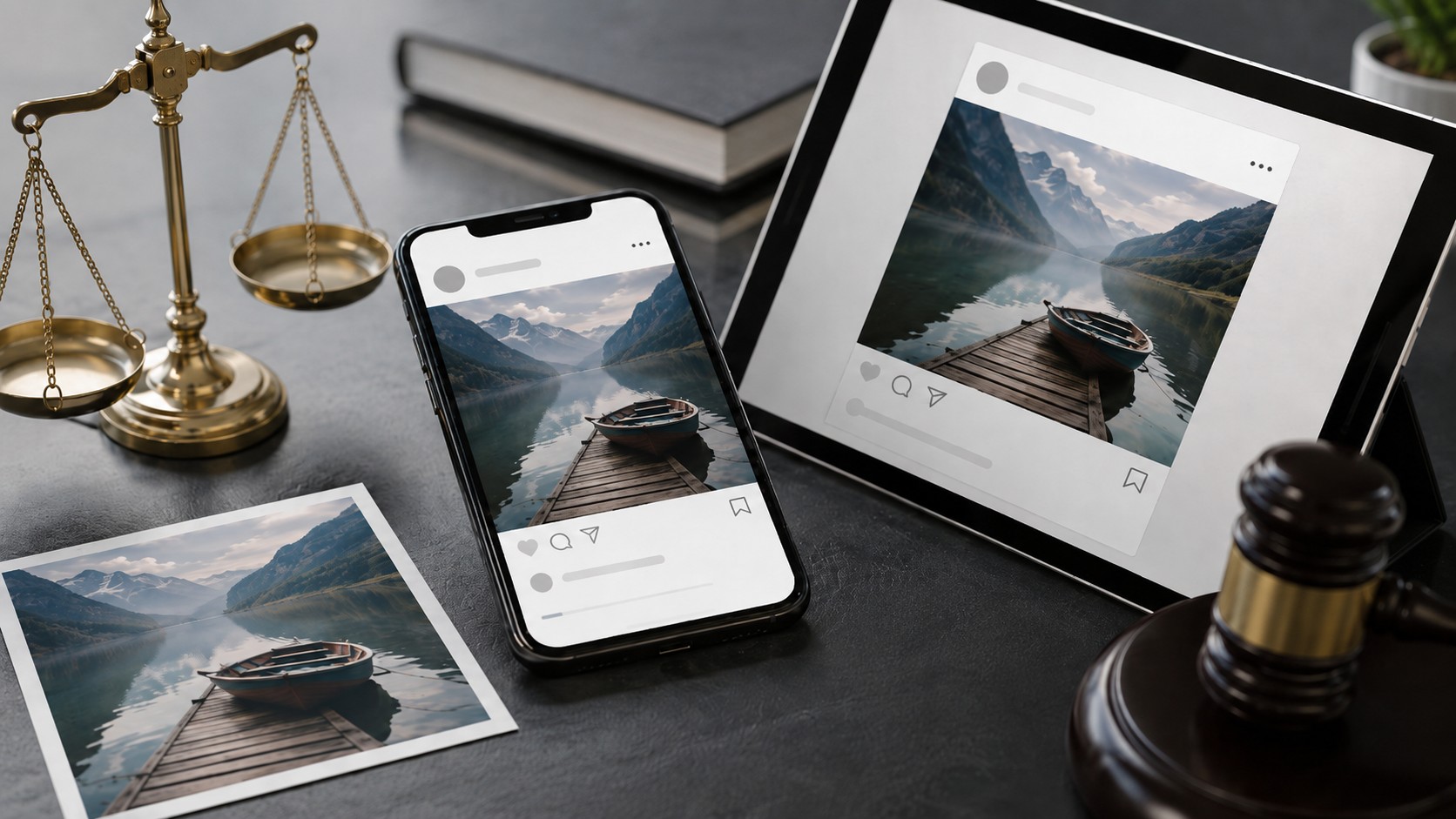
Default answer: you can’t — not without permission. The moment someone presses the shutter, they own the copyright, and reposting their photo means copying and publicly displaying it, both of which are the owner’s exclusive rights. Fair use can excuse that, but it’s a narrow, US-specific legal defence decided case by case on four factors — not a free pass you claim by typing “credit to the owner.” Giving credit isn’t permission. “No copyright infringement intended” is legally meaningless. And “it was public on Instagram” doesn’t make it yours to reuse. The reliable path is boringly simple: get the creator’s okay in writing, use Instagram’s own resharing tools, or stick to content you own or that’s properly licensed. This is general information, not legal advice — for a real dispute, talk to a qualified lawyer.
Let’s kill the most popular myth first
“I gave them credit, so it’s fine.”
It isn’t. Not even close.
Crediting the photographer is polite, and it’s good manners, and it might keep the peace — but legally it does almost nothing. Permission is permission; attribution is attribution; the two are not interchangeable. Courts in the United States have handed down real judgments against people and brands who reposted an image believing a tag in the caption bought them the right to use it. It didn’t. You can name the creator, link their profile, sing their praises in the caption, and still be on the hook for infringement if you never actually got the green light.
So before anything else, unlearn that one. It trips up more people than any other single misunderstanding in this whole area.
The default rule, plainly
Here’s the baseline every other question hangs off.
A photograph is protected by copyright the instant it’s created — no registration required for the right to exist (though registration matters a lot if you ever want to sue). The person who took it holds a bundle of exclusive rights: to reproduce it, to distribute it, to display it publicly, and to make works derived from it. Reposting somebody’s Instagram photo to your own feed touches at least the first three. Which means the starting presumption is infringement, and it’s on you to point to either permission or a legal exception that lets you off.
Permission or exception. Those are the two doors. Everything below is really just a map of them.
What “fair use” actually is (and where it applies)
Fair use is a doctrine in US copyright law. It’s an affirmative defence, meaning it doesn’t stop you being sued — it’s the argument you raise once you are, hoping a court agrees your use was permissible. Outside the States, the cousin concepts differ: the UK, Canada, Australia and others use “fair dealing,” which is generally narrower and tied to specific listed purposes. So if you’re operating from Europe or elsewhere, the American “fair use” framing may not even be the right lens.
When a US court weighs fair use, it runs through four factors, none of them decisive on its own:
|
Factor |
What the court asks |
What helps you |
|---|
| 1. Purpose & character |
Is the use commercial? Is it “transformative” — adding new meaning or message? |
Commentary, criticism, news, parody, teaching; a genuinely new purpose |
| 2. Nature of the work |
Is the original creative or factual? Published or not? |
Factual, already-published works lean more usable than artistic, unpublished ones |
| 3. Amount used |
How much, and was it the “heart” of the work? |
Using less, and not the core, helps — but a photo is often used whole |
| 4. Market effect |
Does your use harm the market or value of the original? |
If you’re not competing with or substituting the original |
One recent development worth flagging. In 2023 the US Supreme Court’s Warhol v. Goldsmith decision sharpened factor one, stressing that when a later use shares essentially the same commercial purpose as the original, “transformative” gets much harder to claim. Translation for Instagram: slapping a filter on someone’s photo and posting it to promote your brand — same purpose, commercial — is a weak fair-use hand, whatever you tell yourself about your artistic vision.
When a repost might squeak through — and when it won’t
Fair use is fact-hungry and unpredictable, so treat this as orientation, not a guarantee.
Leans toward fair use:
- Criticism or commentary — you’re reacting to the image itself, dissecting it, reviewing it.
- News reporting — the photo is itself newsworthy and you’re reporting on it.
- Parody — you’re sending up the original, not just borrowing its appeal.
- Education and scholarship — teaching a technique, analysing a trend, in a genuinely instructional frame.
Leans hard against:
- Decoration — the photo just looks nice on your feed.
- Promotion — you’re using it to sell, market, or build your brand.
- Entertainment reposting — meme-ing, regramming, “curating” someone’s shot because it fits your aesthetic.
- Anything commercial that competes with how the creator would licence the work.
Notice the pattern. The further you drift from saying something about the image and the closer you get to simply using it, the thinner your defence.
More myths, quickly binned
|
The myth |
The reality |
|---|
|
“Credit = permission” |
No. Attribution is not a licence |
|
“‘No copyright infringement intended’ protects me” |
It’s meaningless; intent isn’t the test |
|
“It’s public, so it’s free to use” |
Public visibility ≠ public domain. Still copyrighted |
|
“I found it via search, so nobody owns it” |
Someone almost always owns it |
|
“I cropped it and added a filter — it’s transformative now” |
Editing rarely creates fair use; the core work remains |
|
“Tagging the creator covers me” |
It doesn’t grant you any rights |
|
“Reposting can’t really get me in trouble” |
Statutory damages and takedowns are very real |
How Instagram’s own Terms actually work
People wave “but it’s on Instagram” like a magic charm. Here’s what the Terms really say, minus the folklore.
When you post, you keep your copyright. Your photo stays yours. What you also do is grant Instagram a non-exclusive, royalty-free, transferable, sub-licensable, worldwide licence to host and display your content so the platform can, well, function. Crucial detail: that licence runs to Instagram, not to every other user. Nothing in those Terms hands random accounts the right to lift your image and repost it. So the platform’s licence and a stranger’s “right” to regram are entirely different things — and only one of them exists.
Embedding versus reposting — genuinely different animals
This one’s subtle, and it matters.
Reposting (a.k.a. regramming) means downloading the image and re-uploading it as your own post. You’re making a copy, storing it, publishing it. That squarely implicates the owner’s rights.
Embedding means inserting the original Instagram post into a webpage via Instagram’s embed code — the content still lives on Instagram’s servers; you’re pointing at it, not copying it. Historically that felt safer, and under the so-called “server test” some US courts treated it as not displaying a copy at all. But — and it’s a real but — recent decisions have wobbled on that, and Instagram itself has said its API doesn’t automatically grant embedders a copyright sub-licence. So embedding is lower-risk than reposting, not risk-free, and publishers relying on it may still need a licence or a fair-use argument.
For a plain feed repost, though, none of that nuance rescues you. Embedding on a website is a different act from re-uploading to your grid.
The safe way to share someone’s photo
Right. Enough of what not to do. Here’s the sequence that keeps you clear.
- Just ask. DM the creator, or comment, or email the address in their bio. Attach the exact image so there’s no ambiguity about what you’re requesting.
- Get it in writing. A screenshot of “yeah, go for it — please tag me” is worth infinitely more than a verbal maybe. Save it.
- Honour their conditions. If they say “credit me and don’t crop,” credit them and don’t crop. The permission is only as broad as they granted.
- Use Instagram’s native resharing where it fits — the platform’s built-in reshare and repost features keep attribution intact and the content within Instagram’s rails.
- Lean on content you’re allowed to use — your own photos, properly licensed stock, Creative Commons work (mind the licence terms), or genuine public-domain material.
- For user-generated content campaigns, collect explicit rights — a comment like “#YesBrandYouCanUseThis” or a signed release — before you repurpose a customer’s post.
Do these and the whole copyright question mostly evaporates. Permission is cheap. Litigation is not.
If it’s your photo that got lifted
Flip side, because it happens to creators constantly. Someone reposts your shot without asking, and you want it down.
- Report it to Instagram through the in-app copyright reporting flow, or file a formal DMCA takedown notice with the platform.
- Ask directly first, if you’d rather keep it friendly — often a polite “please take this down or add agreed credit” works.
- Keep evidence — your original file, timestamps, and where it’s appearing.
- Escalate to a lawyer if it’s commercial misuse and the stakes justify it.
And if your image is surfacing on a third-party site that only displays public content, look for that site’s removal route. Ours, for the record, is a dedicated content removal / takedown page — a straightforward way for a rights-holder to ask that material be pulled from our index.
Where Dumpor fits — and where it doesn’t
Let’s draw a clean line, because this is exactly the kind of topic where honesty earns trust.
There’s a world of difference between looking at public content and republishing it. Viewing a public post, studying a creator’s feed, checking what a competitor’s up to — that’s ordinary, low-risk research. Taking that same photo and posting it as your own content is the part that needs permission. Our tools sit firmly on the first side of that line.
-
The anonymous Instagram Story Viewer lets you watch public Stories without logging in and without landing in anyone’s viewer list — handy for quietly researching a creator before you slide into their DMs to ask about a collab.
-
The Instagram Profile Viewer gives you a clean read of a public profile’s posts and highlights, so you can vet a potential partner or reference a style — not lift it.
Now the caveat we won’t soften: viewing or saving a public image for your own reference does not hand you a licence to repost it. If you intend to publish someone’s work on your own account or website, the rules above still apply in full — get permission, or rely on a solid exception. We build tools for anonymous, public-content viewing; we don’t grant, and can’t grant, copyright to anyone. Public content only, and we’re independent of Instagram.
Can I repost someone’s Instagram photo if I give them credit?+
Generally, no. Crediting the creator is courteous but it isn’t legal permission. In the US, reposting a copyrighted photo without a licence is infringement regardless of whether you tagged or named the owner. Credit and consent are separate things — you need the consent.
Is reposting an Instagram photo ever “fair use”?+
Sometimes, but it’s narrow and unpredictable. Fair use is a US legal defence weighed on four factors, and it tends to favour uses like criticism, commentary, news reporting, parody, or education — where you’re genuinely saying something about the image. Simply reposting a photo because it’s attractive, or to promote your brand, rarely qualifies, especially after the Supreme Court’s 2023 Warhol decision tightened the “transformative” analysis for commercial uses.
Doesn’t Instagram’s Terms of Use let me repost other people’s content?+
No. When someone posts, they keep their copyright and grant a licence to Instagram — not to other users. Those Terms don’t give you any right to copy and re-upload another account’s photo. The platform’s licence to operate and a stranger’s supposed right to regram are two entirely different things.
What’s the difference between embedding and reposting, legally?+
Reposting means downloading and re-uploading a copy to your own feed, which implicates the owner’s rights directly. Embedding inserts the original post via Instagram’s code while the content stays on Instagram’s servers. Embedding is lower-risk and some courts have treated it favourably, but the law is unsettled and Instagram has said its API doesn’t automatically grant a copyright sub-licence. Lower risk isn’t zero risk.
Is a photo “public domain” just because it’s public on Instagram?+
No, and this confusion is everywhere. “Public” means visible; “public domain” means free of copyright (because it expired or was dedicated). A photo posted publicly on Instagram is almost always still fully protected. Visibility grants you nothing.
Does editing a photo — cropping, filtering, adding text — make it legally mine?+
Almost never. Minor edits don’t create a genuinely transformative new work in the legal sense, and the protected core of the original remains. Cropping and filtering a creator’s photo to post on your brand account is a classic weak fair-use position.
How do I actually get permission to repost?+
Ask directly and get it in writing. DM the creator with the specific image attached, comment on the post, or email the contact in their bio. Save their reply. Then respect whatever conditions they set — required credit, no cropping, no commercial use. The permission is only as wide as what they agreed to.
Someone reposted my photo without asking — what can I do?+
Report it through Instagram’s copyright tools or file a DMCA takedown, keep evidence of your ownership and the unauthorised use, and consider a direct request for removal or credit. For commercial misuse with real stakes, a lawyer is worth the call. If it appears on a public-content site, use that site’s removal process — ours is our takedown page.
Is this legal advice?+
No. This is general educational information about how copyright and fair use intersect with Instagram. The law is fact-specific and varies by country; for your particular situation, consult a qualified attorney.
Reposting feels casual — a tap, a regram, a nice photo passed along — which is exactly why so many people wander into copyright trouble without noticing the fence they’ve climbed. The mental model that keeps you safe is small and durable: someone owns that image, credit isn’t consent, and fair use is a narrow defence rather than a broad permission. When in doubt, ask; permission takes a minute and settles the whole thing. And when you just need to look — to research a creator, size up a competitor, or reference a public feed before you reach out — that’s the quiet, no-login lane Dumpor was built for, with the bright line firmly drawn between viewing and republishing.

 Telegram bot
|
TikTok Viewer